
The garments you wear to work, to special occasions, and to the events that matter carry more than fabric. Tailored suits, cashmere, silk, and formal gowns represent real investment. How they are cleaned determines how long they hold their shape, color, and fit. The wrong solvent, an incorrect pressing temperature, or a missed stain at intake can quietly undo years of careful wear.
Not every dry cleaner operates at the same level. For families in Highland Park and University Park, where wardrobes often include high-quality tailoring and garments passed between generations, that distinction is worth understanding. The Hillcrest Ave corridor sits at the heart of that community. Choosing a professional dry cleaner in Highland Park, TX, that residents have relied on across decades means knowing what standards to hold them to.
At Avon Cleaners, we have served the Park Cities from our Hillcrest Ave location since 1968. Here is what long-term garment care actually requires, and how to evaluate any cleaner against those standards.

Why Your Choice of Dry Cleaner Shapes Garment Longevity
What Repeated Improper Cleaning Does to Fabric
Improper cleaning shortens garment life and alters fit permanently.
Each cleaning cycle using the wrong solvent, heat, or pressing technique chips away at fiber integrity. Wool loses its body. Silk becomes fragile. Cashmere pills prematurely. A structured jacket can return from a careless cleaner altered in ways that no amount of re-pressing will correct.
Lifecycle Care vs. Single-Visit Cleaning
In Highland Park, where wardrobes often include tailored pieces, occasion wear, and heirloom garments carried across generations, that distinction matters. The dry cleaning services Highland Park households return to are those that treat each garment with the same care on a routine visit as on the first one.
What Professional Dry Cleaning Actually Involves
A professional cleaner reads the garment before treating the stain.
Intake Evaluation: Before Anything Enters a Machine
A properly run cleaning facility inspects every piece at intake. This means checking fiber content to select the correct solvent cycle, identifying any staining, and noting pre-existing damage before it gets attributed to the cleaning process. Pockets are emptied. Rips and loose buttons are documented. Known stains reported at drop-off can be pre-treated, which improves removal results while reducing stress on the fiber.
At Avon Cleaners, every garment receives a unique barcode tag at intake that stays with it through every stage, making mix-ups impossible.
The Five Stages We Use for Every Order
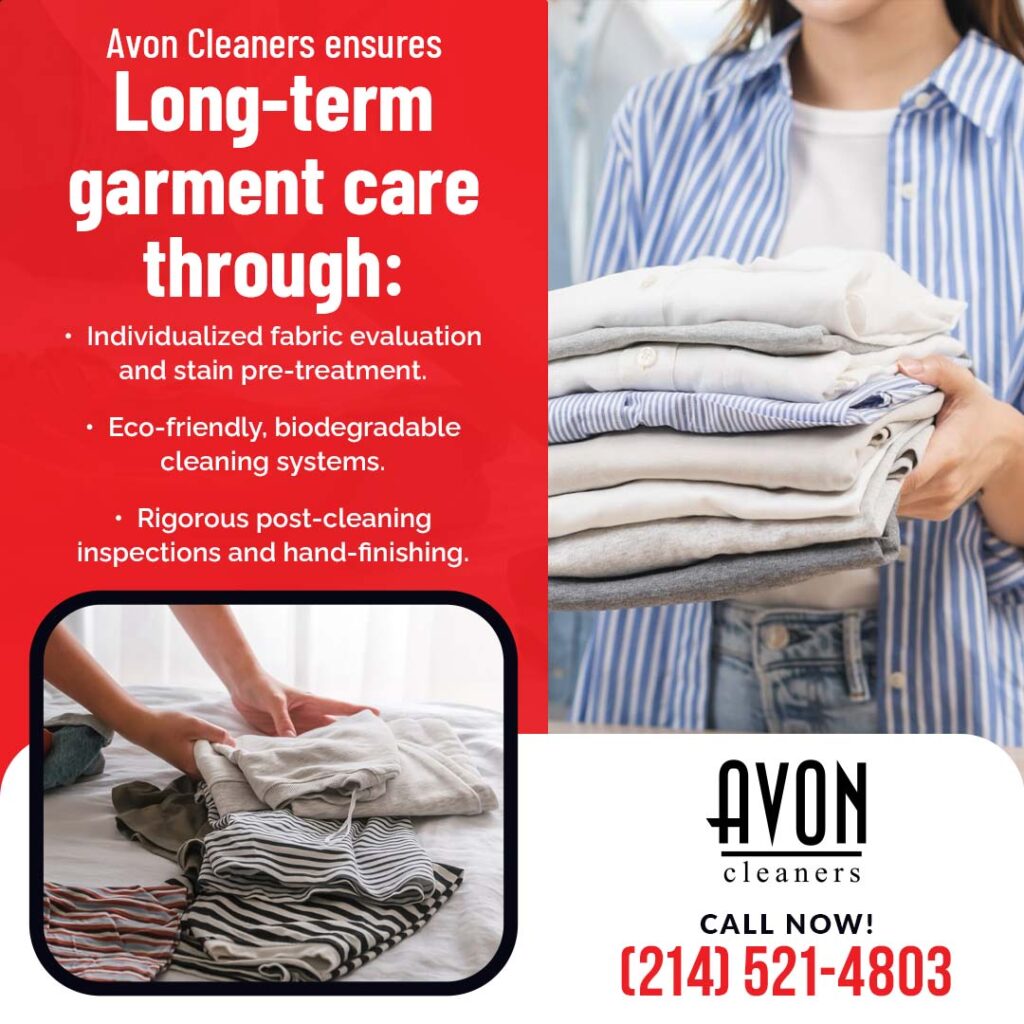
Our cleaning process follows a structured four-stage sequence designed to protect fabric integrity at every step:
- Inspection and custom sorting. Every garment is reviewed at intake and sorted by fabric, color, and construction so each piece receives the specific care it requires.
- System K4 cleaning. Garments are gently washed and dried in our System K4 machine, using a biodegradable solvent that protects fiber integrity while delivering thorough cleaning.
- Pressing and hand finishing. Each piece is hand-finished by our team to ensure the proper drape, shape, and crispness, going beyond what standard pressing alone can achieve.
- Final quality check. Every garment passes a final inspection before it is neatly packaged and returned to you.
That level of process care is what makes us the best dry cleaner Highland Park, TX families have returned to since 1968.
Services Offered at Our Hillcrest Location
As your dry cleaner near Hillcrest Ave, Dallas, Avon Cleaners handles every category a Park Cities wardrobe typically requires:
- Dry cleaning for suits, structured blazers, silk blouses, cashmere, and all delicate fabrics
- Laundered shirts wet-removed from washers, pressed on professional equipment, and inspected for button integrity; any broken or missing buttons are replaced at no extra cost
- Formal and bridal wear, including wedding gown cleaning, preservation, and heirlooming for future generations
- Leather and suede, including smooth leather, grain leather, nubuck, and suede, sent to a specialist with an average turnaround of two to three weeks
- Outerwear, including down jackets, winter coats, and heavy outerwear
- Bedding, including down comforters, duvet covers, afghans, bedspreads, pillow shams, and bed skirts
- Table linens laundered and pressed using professional equipment
- Wash, Dry, and Fold for everyday items such as casual clothes, towels, sheets, and pillowcases (not suitable for dry-clean fabrics)
Our dry cleaning services in Hillcrest also include pickup and delivery across Highland Park, University Park and the broader DFW Metroplex, for a flat $1.50 per trip.
What Eco-Friendly Dry Cleaning Actually Means for Your Garments
We provide eco-friendly dry cleaning in Highland Park, TX, using a solvent that is safer for fabrics, skin, and the environment than conventional options.
Why Perc-Based Cleaning Has Limitations
Perchloroethylene, the solvent most commonly used in traditional dry cleaning, is effective at removing stains. Over repeated cycles, however, it gradually weakens fiber bonds, dulls color brightness, and can leave trace residue on garments worn directly against the skin. For pieces cleaned frequently, such as work suits, cashmere sweaters, and delicate blouses, these effects become noticeable over time.
How SYSTEM K4 Works Differently
Avon Cleaners uses SYSTEM K4, a 100% biodegradable solvent process. Independent dermatological testing returned a result of “very good,” and it is safe on beads, sequins, and embellishments. Colors stay true, fabrics feel softer, and whites hold their brightness. We use a biodegradable solvent on every dry cleaning order.
Questions Worth Asking Any Cleaner
- Is your solvent fully biodegradable, or is that a partial claim?
- Has it been tested for skin safety by an independent institution?
- Is it safe for embellished and beaded formal wear?
Environmental language is easy to use. A documented, tested solvent process is a different standard entirely.
Does Professional Cleaning Extend How Long Garments Last?
Home laundry applies three stressors to fabric at once: heat, mechanical agitation, and water absorption. Together, they cause pilling, fading, and permanent shape distortion. Professional dry cleaning removes heat and water from the process, with agitation that is far gentler than any home washing cycle. The difference in long-term fabric condition:
| Cleaning Method | Fiber Wear Over Time | Color Retention | Garment Shape |
| Home Machine Washing | Higher: repeated heat, agitation, and water exposure accelerate fiber breakdown. | Lower: dyes can fade faster with hot water, long cycles, and harsh detergents. | Reduced: stretching and distortion are more common with rough handling. |
| Professional Dry Cleaning (Perc‑based) | Moderate: gentler on many fabrics than hot‑water washing, but solvent and heat can still stress fibers over many cycles. | Moderate: generally preserves color better than aggressive home washing, though some dyes may dull over time. | Better preserved than standard home washing for many structured garments, but repeated processing can still affect fit. |
| Professional Dry Cleaning (safer solvent, e.g., wet‑cleaning or newer biodegradable systems) | Lower: modern, lower‑impact methods (such as professional wet‑cleaning or newer biodegradable solvents) are designed to minimize mechanical stress and chemical damage. | Higher: controlled cycles often better retain original color by limiting extreme heat and harsh chemistry. | Best preserved: tailored handling, low heat, and water‑free or low‑moisture processing help maintain original shape and structure. |
The choice of solvent in dry cleaning influences the chemical and mechanical conditions under which garments are cleaned, which can affect textile integrity and color retention over repeated cycles.
How to Evaluate a Dry Cleaner Before Committing Your Wardrobe
Quality is visible in the finished garment and in how clearly the team explains their process.
Start with one item before handing over your wardrobe. When you collect it, look for clean pressing lines, flat collar edges, and defined trouser creases. No chemical smell. No chalky residue on dark fabrics. These are process indicators, not cosmetic preferences.
A good test for any professional dry cleaner is how readily they explain what they do.
Ask questions:
- About stain treatment on silk.
- What happens when a care label has been removed
- Which solvent is used
Also, notice the counter staff at drop-off: do they note staining without being prompted? That attention at intake reflects the same care brought to every garment in the back.
A Quick Reference: What to Look for in Any Dry Cleaner
- Fabric knowledge: Do they evaluate each piece before choosing a cleaning method?
- Solvent safety: Is the cleaning agent documented, tested, and gentle on skin?
- Hand finishing: Is every garment pressed by hand and inspected before it goes out?
- Tracking system: Does each item carry an ID to prevent loss or mix-up?
- Consistency: Can you count on the same results at every drop-off?
Any dry cleaner you choose should meet every one of these standards without exception.
Mistakes to Avoid When Choosing a Dry Cleaner in the Park Cities
Treating Price as the Primary Filter
A lower price nearly always reflects a trade-off somewhere in the process: a shorter cleaning cycle, a less selective solvent, or machine pressing instead of hand finishing. For casual garments, that compromise may be acceptable. For tailored, structured, or delicate pieces, it tends to show up within a few cleaning cycles.
Skipping Questions About Fabric Handling
Not every facility has the training or equipment to handle luxury fabrics appropriately. Before leaving a cashmere coat, a beaded gown, or a vintage piece, ask how the cleaner approaches that specific fabric type. Ask whether they have experience with embellishments, delicate linings, or structured garments. A cleaner that cannot answer those questions specifically is not the right match for that piece.
Undervaluing Consistency
A single strong result is less meaningful than the same result across twenty visits.
Inconsistency in cleaning quality reflects process instability. Ask how long the senior pressers and cleaners on staff have been with the facility. Staff longevity is a practical indicator of whether processes are well-established and reliably followed.
Why Access and a Long-Term Relationship Both Matter
Location Makes Regular Care Practical
Our 6301 Hillcrest Ave location sits along routes that many Highland Park and University Park families travel as part of their daily rhythm. That proximity makes regular garment care easier. For those who prefer not to come in at all, pickup and delivery covers the same neighborhoods for a flat $1.50 per trip.
As a dry cleaner near Hillcrest Ave, Dallas, we build personal service relationships through our delivery team, who come to know each customer’s wardrobe and preferences over time.
What Happens When We Know Your Wardrobe
A long-term customer does not need to explain their preferences at every visit. We already know which suit needs gentle pressing, which shirts should be folded rather than hung, and which pieces need a closer review after cleaning. We are proud to be professional dry cleaners in Hillcrest, Dallas, that residents return to. We have earned that relationship by applying accumulated knowledge, not starting from scratch each time.
Frequently Asked Questions
How often should tailored suits be dry-cleaned?
Suits worn regularly should be cleaned every three to four wears. Soil left in the weave weakens fibers over time. Seasonal pieces should go into storage clean, not come out of it clean.
Is SYSTEM K4 safe for beaded and embellished formal wear?
Yes. SYSTEM K4 is tested safe on delicate fabrics, beads, sequins, and embellishments. Because it uses no heat in the cleaning process, it avoids the melting and discoloring that heat exposure can cause on glued-on beads and sequins.
How long does leather and suede cleaning take?
Leather and suede go to a specialist and are not processed in-house. Turnaround is typically two to three weeks. Ask at drop-off for a specific timeline.
Choosing Wisely Now Protects Your Wardrobe for Years
Your wardrobe reflects the care you put into how you present yourself. The dry cleaner you choose either protects that or gradually diminishes it. A reliable long-term cleaner makes the difference visible over the years, not just on the day you pick up a single garment.
Every visit should produce the same care. That is the standard to hold a cleaner before you give them your wardrobe.
Looking for a dry cleaner near SMU that provides all the garment care services you need? Avon Cleaners has served Park Cities families since 1968. We hand-finish every garment, clean with 100% biodegradable SYSTEM K4 solvent, and offer pickup and delivery across the DFW Metroplex for a flat $1.50 per trip. Visit us at 6301 Hillcrest Ave, Dallas, TX 75205, call (214) 521-9927, or schedule your first pickup online. We are open Monday through Friday, 8 AM to 4 PM, and Saturday, 9 AM to 1 PM. Sunday: Closed (with 24/7 kiosk pickup/drop-off).
