
Most wardrobe damage does not happen from wear. It happens in the wash.
If your household runs laundry loads that mix dress shirts, athletic wear, kids’ school clothes, and everyday linens, often all in the same week. You already know how quickly things can go wrong. A faded collar, a shrunken knit, a dress shirt that never quite recovers its shape. We see this kind of damage at Avon Cleaners on Hillcrest Avenue regularly, and in most cases, it traces back to handling decisions that are easy to get right with the right knowledge.
Most laundry damage is preventable. Here is what proper sorting, wash temperatures, fabric-specific handling, and drying actually look like, and how our professional service to wash and fold laundry in Highland Park, TX, approaches each step.

Why Sorting Is the Foundation of Fabric Protection
Sorting is the single most important step before any load goes into the machine.
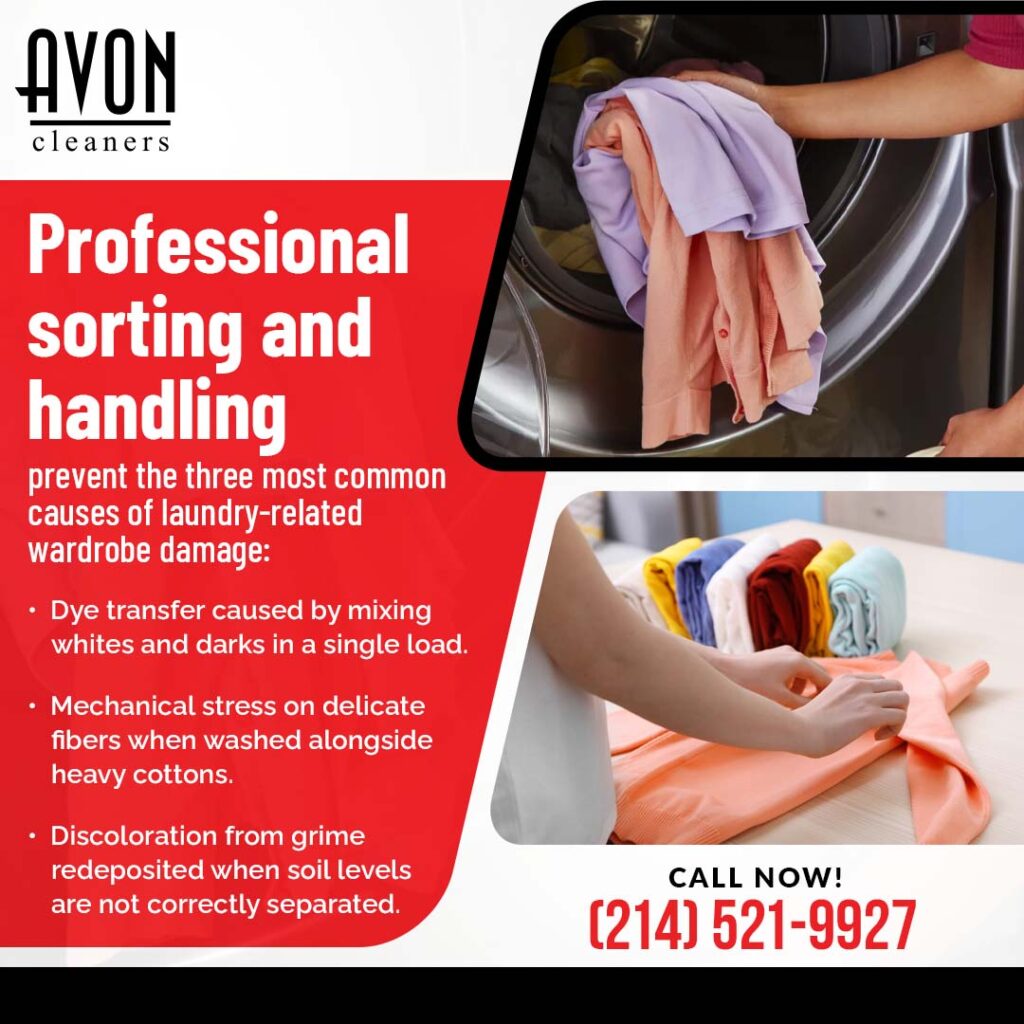
In our experience, most fabric damage traces back to one skipped step: sorting. When you wash whites and darks together, dye transfers onto lighter pieces. When fine knits share a drum with heavy cotton towels, the friction wears down delicate fibers. When lightly worn items wash alongside heavily soiled ones, loosened grime redeposits onto the cleaner clothes.
We sort every load by color and fabric type before it touches water. Good sorting practice also accounts for how soiled each item is – lighter-worn pieces and heavily soiled ones wash better separately. Here is why each category matters:
| Sorting Category | Items Grouped Together | What It Prevents |
| By Color | Whites, lights, darks | Dye transfer and color fade |
| By Fabric Type | Cotton, synthetics, delicates | Cycle and temperature mismatches |
| By Soil Level | Lightly worn vs. heavily soiled | Dirt redepositing onto cleaner items |
If your weekly laundry includes dress shirts, country club attire, workout clothes, and everyday casualwear, most of those loads belong in separate cycles. When you combine them for convenience, each garment gets settings that are wrong for at least part of what is in that load.
Water Temperature and Wash Cycles: What the Labels Actually Mean
Each temperature setting is designed to protect a specific category of fabric.
- Hot water is appropriate for heavily soiled cottons, white towels, and bedsheets.
- Cold water is right for darks, synthetics, and fabrics prone to color bleed or shrinkage.
- Warm water works for general mixed cotton loads that are neither heavily soiled nor delicate.
Cycle selection matters just as much as temperature. The American Cleaning Institute (ACI) advises using a delicate or low-heat cycle for lightweight and heat-sensitive fabrics, while a standard cycle suits everyday cottons and linens. Heavy-duty cycles belong only on thick workwear and household linens.
The most common home washing error is applying one temperature and one cycle to everything. Cotton contracts differently under heat than polyester does. When you apply uniform settings to a mixed load, you accelerate wear on every garment in it. It is something we correct for with every load we handle.
How Specific Fabric Types Need to Be Handled
Delicates and Fine Fabrics
Silk, fine knits, lace, and embellished items are the fabrics most commonly damaged by standard washing, and the ones that benefit most from professional handling.
Delicate fabrics are vulnerable to two things that home washing routinely applies: mechanical agitation and heat. Standard cycles put fine fibers under repeated stress that degrades their structure. A silk blouse or fine cashmere knit exposed to drum contact, temperature variance, and spin forces, even on a home gentle setting, does not hold up over time.
We treat delicates with fabric-appropriate settings and controlled temperatures. Your fine fabrics come back with their texture, drape, and shape intact; not stretched, pilled, or distorted from the wrong wash. If you have silk, fine knitwear, or embellished pieces sitting unwashed because you are unsure how to handle them, our laundry service in Highland Park, TX, is built for exactly that.
Laundered Shirts and Dress Shirts
Our laundered shirts process follows four steps that a home washing machine cannot replicate.
We start with a close inspection of each shirt. We pre-treat collars, cuffs, and any stained areas by hand before the shirt enters water; this is where the most concentrated soiling builds up and where home washing falls shortest. We then wash each shirt in protective netting, which protects buttons from damage during the cleaning cycle and preserves the fabric throughout. After washing, we use a dedicated press to perfectly shape the collar and cuffs, followed by a precision Sankosha press on the shirt body that delivers a crisp, structural finish. Before the shirt is packaged, a final hand-inspection confirms every button is secure, and the press is flawless.
When your shirts go through a home wash, collars take direct drum contact without pre-treatment. Your cuffs develop yellowing that a regular wash cycle does not lift. Buttons weaken gradually from standard agitation. The difference between a home-washed dress shirt and one through our laundered shirts service is visible the moment you put it on.
For anyone in the Park Cities who wears dress shirts to work, country club events, or formal occasions, this is the area of laundry care that delivers its clearest return.
Everyday Cotton and Casual Wear
Everyday cottons: workwear, casual shirts, kids’ clothes, activewear, make up the bulk of most households’ laundry. They are not delicate, but they are not indestructible. Untreated cotton can experience noticeable dimensional change during the first wash, especially when laundering conditions are not matched to the fabric; testing standards such as AATCC 135 measure these changes after home laundering.
Common mistakes that accelerate wear on everyday cotton include overloading the drum, ignoring temperature settings, and leaving open zippers to snag other fabrics in the load. A packed machine cannot circulate water effectively, which means items come out less clean despite the extra wear on the fabric.
When our team handles your everyday wash, dry, and fold laundry, we apply the right temperature, cycle, and load size to each batch; the steps that protect fabric over time and that most households skip when the week gets busy.
Drying: The Step That Damages Fabrics Most When Done Wrong
High heat is the leading cause of fabric shrinkage, lost elasticity, and faster fiber wear.
In our experience, the damage done in the dryer often exceeds what happens in the wash. High-heat tumble drying causes cotton to tighten, breaks down the elastic in waistbands and cuffs prematurely, and causes synthetic performance fabrics to pill and distort. ACI’s Cold Water Saves initiative says that following the water-temperature directions on garment care labels can help reduce fading, shrinking, and bleeding, which can help clothes last longer.
Your knits and wool blends should be dried flat, not tumbled. Even a low-heat dryer cycle permanently stretches or compresses these fabrics. The weight of a soaked knit, hung to dry, pulls it out of shape. Flat drying on a clean horizontal surface is the only method that preserves original dimensions.
For Dallas households in May and into summer, leaving damp laundry in a closed drum creates mildew quickly in warm, humid conditions. Getting items out promptly and folded or hung right away prevents the set-in wrinkles and musty odor that re-washing alone rarely fixes.
We account for all of this in our wash, dry, and fold service: drying garments at temperatures matched to each fabric type, monitoring cycle times, and folding items while still warm so they arrive back fresh and wrinkle-free.
What Sets a Professional Wash and Fold Laundry Service Apart
We apply the right handling to every load, not just when there is time for it.
At a self-service laundromat, every decision rests with you: sorting, temperature, cycle type, drying time, and folding. One oversight on a busy day compounds into damage across weeks. A professional service removes that variability. Our trained team sorts each load correctly, washes and dries at appropriate settings, and folds in a way that keeps garment structure intact.
Avon Cleaners has been voted the best cleaners by Park Cities People multiple times. That recognition reflects the kind of consistent, detail-focused care that most households simply do not have time to give every load. We apply the same standards to your everyday laundry as we do to formal garments: hand finishing, quality checks, and personal service that gets to know your preferences over time.
The results are tangible. Your shirts come back pressed and shaped, your fabrics hold their color week after week, and your household linens return folded and fresh, ready to put away, not re-wash.
We also accommodate same-day laundry service in Highland Park, TX, for time-sensitive situations: graduation weekends near SMU, country club event preparation, or any stretch when your regular schedule gets away from you.
We clean with SYSTEM K4, a 100% biodegradable solvent process that makes us the only cleaner in Dallas using entirely earth-friendly products. That standard applies across everything we offer, including our service for fluff and fold in Highland Park, TX.
New customers receive 20% off their first visit. SMU students receive 20% off every time with a valid student ID.
How Our Pickup and Delivery Service Works
Getting started with our pickup and delivery of laundry in Highland Park, TX, takes just a few minutes.
Here is how it works:
- Create your account at avoncleaners.com or through the Avon app.
- Request a pickup at a time that works for your schedule.
- Your Avon delivery agent arrives at your home or office during your pickup window.
- We sort, wash, dry, and fold your laundry using the correct settings for each fabric type.
- Everything is returned fresh, folded, and packaged on your next scheduled delivery date.
Prefer to drop off yourself? Our Hillcrest Ave location has 24/7 kiosk access so you can leave your laundry whenever it suits you, morning, evening, or on a weekend.
We serve Highland Park, University Park, the SMU corridor, Frisco, Plano, Addison, and the wider DFW Metroplex.
Take Laundry Off Your List
Proper sorting, correct temperatures, fabric-aware handling, and controlled drying are what keep your clothes looking right over time. Most households cannot apply all of these steps consistently, every load, every week.
That is the gap Avon Cleaners fills; family-owned since 1968, with hands-on garment care that Park Cities families have counted on for over five decades. Call us at (214) 521-9927, email us at service@avoncleaner.com, or create your account online if you need laundry service near SMU or neighboring areas. Find us at 6301 Hillcrest Ave, Dallas, TX 75205.
